Diario de Yucatán: Traductor en maya ("Translator in Maya")
 Diario de Yucatán, Ciudadanos section, August 17, 2026
Profiles of our people
Translator in Maya
Seeking to bring the regional language into technology
Research developed in Yucatán to bring the Maya language closer to new technologies reached one of the world’s most important academic stages in artificial intelligence.
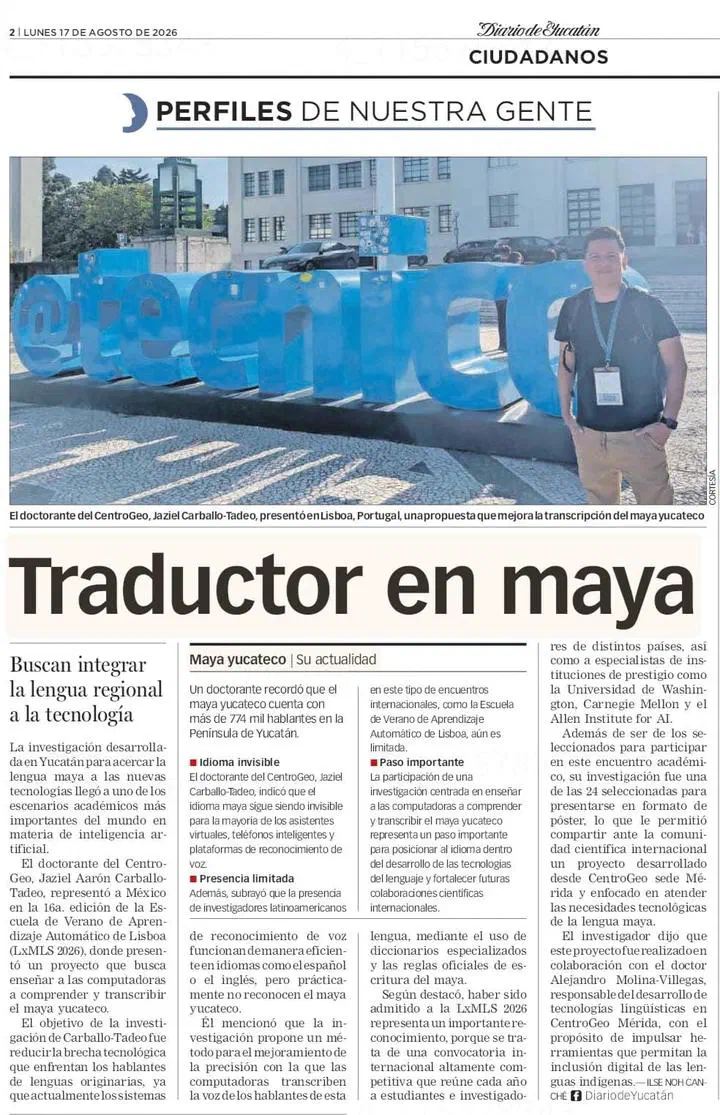
CentroGeo PhD candidate Jaziel Aarón Carballo-Tadeo represented Mexico at the 16th Lisbon Machine Learning School (LxMLS 2026), where he presented a project aimed at teaching computers to understand and transcribe Yucatec Maya.
The goal of Carballo-Tadeo’s research was to reduce the technological gap faced by speakers of Indigenous languages, since current speech-recognition systems work efficiently for languages such as Spanish or English but barely recognize Yucatec Maya.
He noted that the research proposes a method to improve the accuracy with which computers transcribe the speech of Yucatec Maya speakers, through the use of specialized dictionaries and the official rules of Maya orthography.
He highlighted that being admitted to LxMLS 2026 is a significant recognition, since it is a highly competitive international call that brings together students and researchers from different countries each year, along with specialists from prestigious institutions such as the University of Washington, Carnegie Mellon, and the Allen Institute for AI.
In addition to being selected to take part in the academic gathering, his research was one of 24 selected for poster presentation, allowing him to share with the international scientific community a project developed at CentroGeo’s Mérida campus and focused on addressing the technological needs of the Maya language.
An invisible language
CentroGeo PhD candidate Jaziel Carballo-Tadeo said the Maya language remains invisible to most virtual assistants, smartphones, and voice-recognition platforms.
Limited presence
He also stressed that the presence of Latin American researchers at international gatherings such as the Lisbon Machine Learning School is still limited.
An important step
Presenting research focused on teaching computers to understand and transcribe Yucatec Maya marks an important step toward positioning the language within language-technology development and strengthening future international scientific collaborations.
The researcher said the project was carried out in collaboration with Dr. Alejandro Molina-Villegas, who leads the development of language technologies at CentroGeo Mérida, with the goal of advancing tools that enable the digital inclusion of Indigenous languages.
Article by Ilse Noh Canché, published in Diario de Yucatán on August 17, 2026. Translated from the original Spanish for this archive.

Jaziel A. Carballo Tadeo
PhD Candidate in Geospatial Information Sciences
PhD candidate at CentroGeo’s National Geointelligence Laboratory, researching the use of artificial intelligence for the preservation of Yucatec Maya.